
KushoAI vs Postman: Your API Collaboration Tool Is Not Your Testing Strategy
Postman is open in most engineering teams all day. It is where APIs are designed, endpoints are explored, and collections are shared across the team. It is genuinely excellent at all of that. But somewhere along the way, teams started treating Postman monitors and collection runners as a testing strategy, and that is where the gap opens up.
Postman was built for collaboration. The moment you need tests that run automatically, catch regressions on every commit, and update themselves when your API changes, you are asking it to do something it was never designed for.
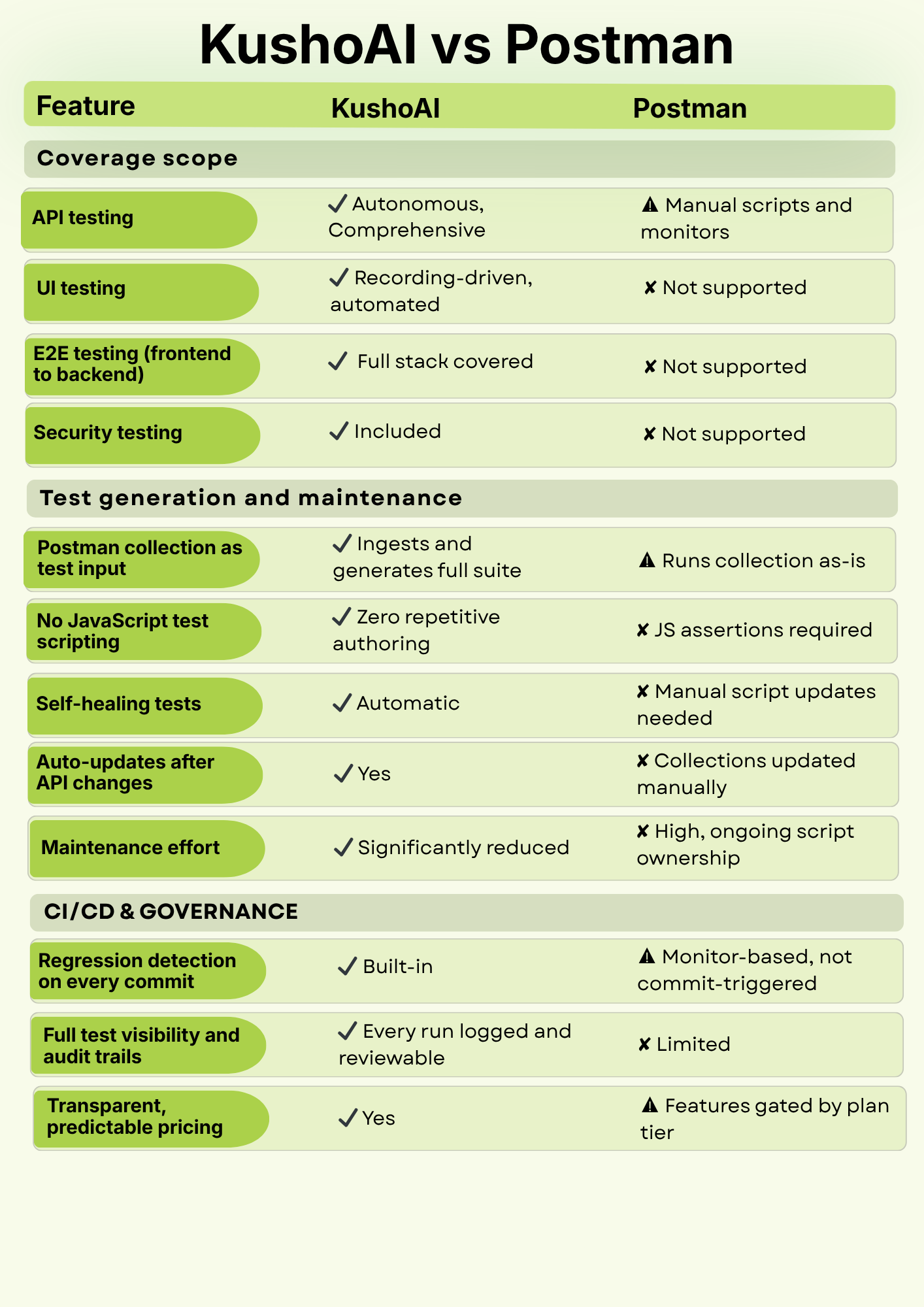
KushoAI (Autonomous with full visibility). Feed KushoAI your Postman collection or OpenAPI spec, and it generates a complete, ready-to-run test suite covering API, UI, E2E, and security. When your codebase changes, it detects the diff and updates the tests itself.
Your QA team has full visibility into every run and every failure without needing to own or maintain the test logic themselves.
Postman (API collaboration platform with manual testing capabilities). Postman is built for API design, documentation, and exploration. Its testing features, Collection Runner, Monitors and JavaScript assertions were added to support manual validation workflows, not autonomous quality assurance.
They work, but they require someone to write and maintain the test logic, and they were never intended to be the backbone of a CI/CD testing strategy.
What Postman Testing Actually Looks Like in Practice
A developer creates a new endpoint and adds it to the Postman collection. Someone then writes JavaScript assertions to validate the response. These assertions work well until the next release changes a field name or adds a required header, causing the tests to fail. Unfortunately, nobody notices this issue for two days because Postman monitors run on a schedule rather than immediately following every code commit. Eventually, someone is assigned to fix the problem. This cycle repeats with each sprint, often going unnoticed, as many do not consider it a testing issue since Postman is not primarily designed as a testing tool.
That is exactly the problem. The overhead is real; it just does not have a name.
What KushoAI Does With Your Postman Collection
You do not have to abandon Postman or migrate away from your existing collections. KushoAI reads them directly.
Bring your Postman collection into KushoAI, and it uses it as the input to generate a complete, production-ready test suite. A real test suite covering your APIs, your UI flows, your E2E journeys, and your security surface, maintained automatically as your spec evolves. Your collections go from being documentation to being the foundation of a testing strategy that actually runs itself.
Your QA team stays in control throughout. Every run is logged, every failure is visible, and every change is traceable. KushoAI handles the routine work. Your team handles the judgment calls.
The Coverage Gap Nobody Talks About
Postman tests APIs only. Your UI, security surfaces and E2E flows are untested. For teams running Postman monitors as their primary quality signal, that is a significant blind spot, and it only becomes visible after something breaks in production that a scheduled monitor had no way of catching.
KushoAI covers the whole surface. The same tool that validates your API responses also tests the UI flows your users walk through, the end-to-end journeys that span multiple services, and the security layer beneath it all. One tool, one view, one place your QA team goes to understand the health of the entire product.
Where Postman Still Belongs
Postman is the best API design and collaboration tool available. Use it to design your APIs, document your endpoints, share collections across the team, and explore behavior during development. It is genuinely excellent at all of that, and no tool does it better.
Just stop asking it to be your testing strategy. That is what KushoAI is for.
Up and Running Before Lunch
No JavaScript test scripts to write. No monitors to configure. No collection maintenance to own.
Export and import. Take your existing Postman collections straight into KushoAI. It reads them and generates a complete, production-ready test suite automatically across API, UI, E2E, and security.
Connect your pipeline. GitHub Actions, GitLab CI, Jenkins — KushoAI integrates natively in minutes with no custom configuration.
Ship. Most teams are fully running the same day. Your Postman collections become the input. Your QA team gets the visibility and control. The scripts nobody wanted to maintain are gone.
Member discussion