
KushoAI vs Momentic: Full-Stack vs UI Testing
Momentic tests your UI. KushoAI tests your entire product.
Momentic is a well-built UI testing tool. If your only concern is validating what users see on screen, it does that job well. But modern software breaks in more places than just the UI APIs failing, backend services regressing, security gaps opening up, and Momentic has no answer for any of that. KushoAI is built to cover the full picture, from backend to frontend, with your QA team in control of what matters.
KushoAI (Full-stack autonomous testing) Feed KushoAI your spec or Postman collection, and it generates a complete, ready-to-run test suite covering API, UI, E2E, and security. When your codebase changes, it detects the diff and updates the tests itself. No ticket. No sprint item. Your QA team stays focused on what needs their judgment, not on routine upkeep.
Momentic (UI-only, flow-authored) Momentic lets your team describe UI test flows in plain English, and its AI handles execution. It is genuinely faster than writing Playwright or Cypress by hand. But it is scoped entirely to the frontend. Your APIs, backend services, and security surface are outside its coverage entirely, and every UI test still starts with a human describing the flow.
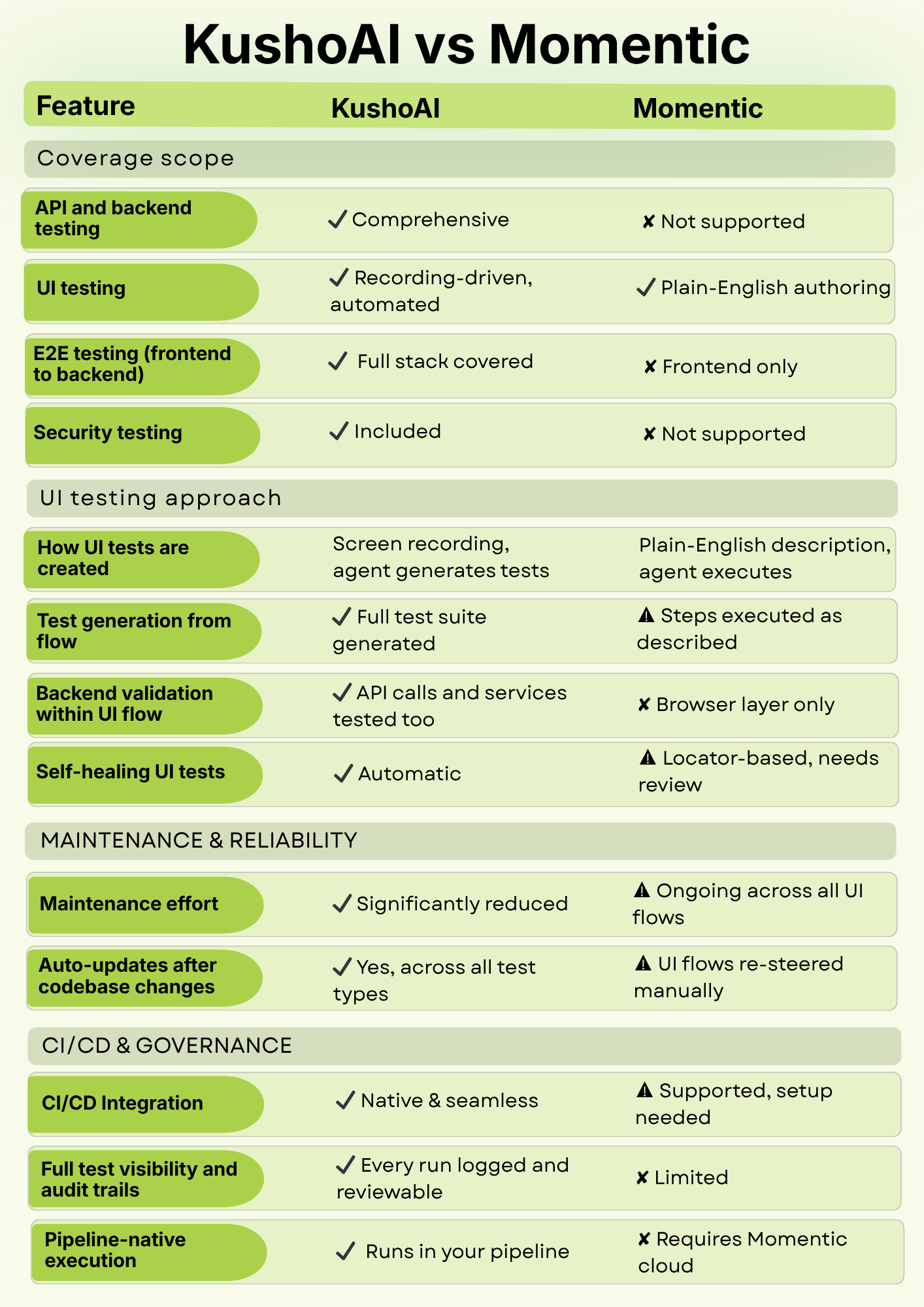
How they stack up
A UI Testing Tool Is Not a Testing Strategy
Momentic is good at what it does. It converts plain English descriptions into UI tests, self-heals locators when the DOM changes, and helps teams build frontend coverage faster than traditional frameworks. For teams whose entire testing surface is the browser, that is a reasonable fit.
But most software teams are not in that position. APIs fail independently of the UI. Backend services regress in ways the frontend never surfaces. Security vulnerabilities live below the layer Momentic can see. A team running Momentic exclusively is testing one floor of a multi-story building and calling it covered.
KushoAI is built for the whole building. The same tool that tests your UI also validates your APIs, runs your E2E flows from frontend to backend, and covers your security surface. Your QA team gets a single, unified view across the entire stack, with full visibility into every run, without having to stitch together separate tools for each layer.
How UI Testing Works Differently in KushoAI
Both KushoAI and Momentic require a human to define the UI flow upfront. That is not the differentiator. The difference is in what happens after, and how far the tool actually goes.
With Momentic, your team describes the flow in plain English. With KushoAI, your team records it by walking through the actual journey in the product, like opening a page, clicking search and adding to cart. From that recording, KushoAI's agent automatically generates the full test suite. You are not writing test logic; you are showing the tool what the flow looks like and letting it handle everything from there.
More importantly, that recording is just the UI layer. KushoAI tests what happens beneath it, too. The same tool that validates your frontend flow also tests the API calls behind it, the backend services it depends on, and the security surface it touches. Momentic stops at the browser. KushoAI keeps going.
Up and Running Before Lunch
No flow descriptions to write. No test cases to migrate. No agent to configure.
Export and import. Bring your existing Postman collections or OpenAPI specs into KushoAI. It reads the spec and generates your complete test suite automatically across API, UI, E2E, and security.
Connect your pipeline. GitHub Actions, GitLab CI, Jenkins and more, KushoAI integrates natively with no custom setup required.
Ship. Most teams are fully running the same day. Your QA team stays in control and informed. What disappears is the authoring backlog and the coverage gap that a UI-only tool was never going to close.
Member discussion